
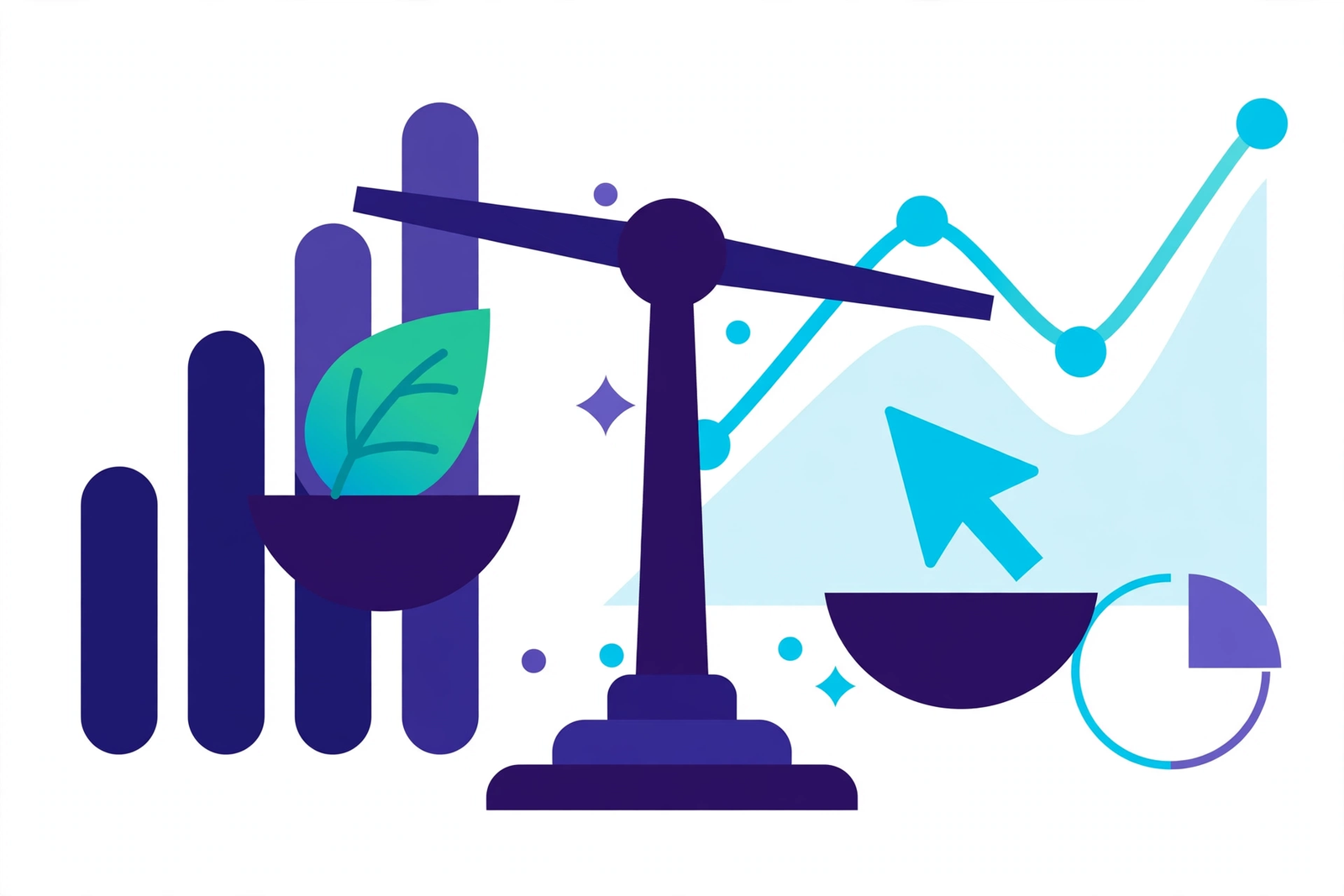
It’s one of the first questions almost every UK business asks when it starts taking online marketing seriously: should we invest in SEO, or put the budget into PPC advertising?
The honest answer is that it isn’t really an either-or choice. SEO and PPC do different jobs. SEO builds a long-term asset that keeps bringing customers to your door. PPC rents you visibility the moment you need it. Which one deserves your money first depends on your budget, your timescales and how competitive your market is — and this guide will help you work that out.
Below, we compare how each channel works, what it costs and how quickly it delivers. If you’d rather talk it through, our team handles both sides — SEO services and paid media — so we have no axe to grind either way.
How SEO and PPC actually work
SEO (search engine optimisation) is the work of improving your website so it ranks higher in the organic search results — the unpaid listings in Google’s search engine results pages. It covers three broad areas: technical health (a fast, crawlable site with no errors), content (pages that genuinely answer what people search for) and authority (links and mentions from other reputable websites). When it works, your pages show up for your customers’ everyday searches, and each click costs you nothing at the point of contact.
PPC (pay-per-click) is pay per click advertising, most commonly the sponsored listings at the top of Google’s results, managed through Google Ads. You bid on keywords, your advert appears when someone searches for them, and you pay only when a person actually clicks. Where the advert sits, and what each click costs, comes down to ad rank — a blend of your bid and your quality score, Google’s rating of how relevant your advert and landing page are. It also pays to respect keyword intent: someone comparing options needs a different advert and a different page from someone ready to buy today. Meta, LinkedIn and Microsoft Advertising offer their own versions, but the principle is identical: visibility is bought, auction by auction, click by click.
The simplest way to think about it: SEO is buying and improving the shop; PPC is paying for a prime pitch in the market square. Both put you in front of customers — they just get you there in very different ways, which is why our digital marketing team plans the two together rather than in isolation.

Speed of results: days versus months
This is the starkest difference between the two channels. A PPC campaign can be live within days. Once your adverts are approved and your landing pages are ready, you can appear at the top of Google almost immediately — and enquiries can follow just as fast. That speed makes PPC the go-to channel for product launches, seasonal promotions, entering a new area or simply testing whether a market is worth pursuing.
SEO plays a longer game. A brand-new website in a competitive sector may take many months before it ranks for commercially valuable searches, because Google needs time to crawl, assess and trust the site. Established sites with solid foundations usually see movement sooner, but there are no honest shortcuts: anyone promising page one next week is selling you something that doesn’t exist.
The trade-off is what happens later. PPC traffic stops the day you pause the campaign. SEO, once established, keeps delivering — the work compounds rather than expiring.
What each one costs — and how the costs behave
Neither channel is free, but the money flows in completely different patterns. With PPC, the cost structure is transparent and immediate. You set a daily or monthly budget, and every click is charged against it at a cost per click set by auction competition. In fiercely contested UK markets — legal services, finance, home improvements — a single click can be expensive, because several businesses are bidding for the same customer. Your costs are roughly proportional to the traffic you buy, and if you stop paying, the traffic stops with it.
SEO is an ongoing investment rather than a meter running by the click. You pay for expertise — strategy, technical fixes, content creation and link building — typically as a monthly retainer or project fees, whether that’s an in-house hire, a freelancer or an agency. The return profile is back-loaded: early months can feel quiet while foundations are laid, but as rankings climb, the cost of each additional visitor falls steadily. A page ranking near the top can bring in enquiries month after month with no per-click charge attached.
So which is cheaper? In the short term, usually PPC — a modest test budget buys real data within weeks. Over a year or more, a successful SEO campaign typically delivers a far lower cost per enquiry, because you’re no longer renting every visit.
Trust and click behaviour: do people prefer organic results?
Searchers are not naive. Most people can tell an advert from an organic listing at a glance, and a meaningful share deliberately scroll past the ads to the “real” results, treating a high organic ranking as a sign of trustworthiness. Organic listings tend to earn the higher click-through rate overall, particularly for research-style searches.
That said, when someone is ready to buy, the distinction matters less. A well-written advert that matches exactly what a person typed, on a page that loads fast and makes enquiring easy, converts perfectly well. For high-intent searches — an emergency service, a specific product — the sponsored results are often where the action is.
The practical takeaway: SEO builds credibility and captures the broadest demand, while PPC captures demand at the sharp end — including searches where your organic presence is weak or non-existent.
When SEO is the better bet
- You want a lasting asset. Rankings, content and authority stay yours; they don’t vanish when a monthly budget runs out.
- Your customers research before they buy. If people compare options, read guides and take weeks to decide, organic content is where you’ll meet them.
- Your margins can’t carry high click costs. In sectors where clicks are pricey, organic traffic protects profitability.
- You’re building a brand. Appearing consistently in organic results across your whole field builds recognition that advertising alone rarely achieves.
- You can afford patience. If the business is stable and you can invest steadily, SEO usually wins on lifetime value.
Not sure where your site currently stands? A free SEO audit will show you what’s helping, what’s hurting and how big the opportunity is — before you commit a penny.
When PPC is the better bet
- You need enquiries now. A new business, a quiet period or spare capacity to fill — PPC is the fastest lever you can pull.
- You’re launching something time-limited. A new product, a seasonal offer or an event has a window that SEO simply can’t hit in time.
- You’re testing a market. PPC data tells you within weeks which keywords convert, which messages land and what a customer is actually worth.
- You serve a defined area or niche. Geo-targeting lets a local firm spend only on people nearby who are ready to buy.
- Your website already converts well. If visitors turn into customers at a healthy rate, paid traffic often pays for itself from the start.
Our PPC and Google Ads specialists build campaigns around exactly these situations — tightly targeted, tracked to the enquiry, and scaled only when the numbers justify it.
Why most growing businesses end up using both
Talk to businesses that have marketed online successfully for a few years and a pattern emerges: they rarely chose one channel forever. They sequenced them.
A sensible sequence looks like this. Start with PPC to generate enquiries immediately and, just as importantly, to gather hard data — which search terms produce customers, what those customers are worth, which pages convert. In parallel, invest in SEO: fix the technical foundations, build the content those proven keywords deserve, and earn authority steadily. As organic rankings climb and enquiries start flowing without a per-click charge, you can hold or trim the PPC budget, keeping it for launches, seasonal peaks and the ultra-competitive terms where organic ground is hardest to win.
The two channels also reinforce each other. PPC data sharpens SEO targeting; a strong organic presence lowers your overall cost per acquisition; and appearing in both the adverts and the organic results on the same page makes your business very hard to ignore. It’s not duplication — it’s owning more of the results page.
There’s a practical workflow behind that reinforcement, and it runs on data. Good Google Ads management starts with measurement: set up conversion tracking properly — in Google Ads and Google Analytics — and every click starts telling you something useful: which keywords carry genuine buying intent, which landing pages convert visitors into enquiries, and which need landing page optimisation before they deserve more traffic. Feed that evidence back into your SEO and you stop guessing what content to write. Google Search Console completes the picture from the organic side, showing the queries already earning you impressions in the search engine results pages — often including terms worth bidding on straight away while their organic pages climb. Then there’s remarketing, the part of pay per click advertising that carries on after the first visit: tailored adverts shown to people who browsed key pages but didn’t enquire, keeping your brand in front of warm prospects at a modest cost per click. Run the two channels with that discipline and they stop being rival line items — they become a single search strategy, each covering the other’s blind spots.

A simple decision framework
Still torn? Run your situation through these four questions:
- Budget. Can you sustain a monthly investment for at least six months? SEO needs consistency to compound. If funds are tight, a focused PPC test may tell you more, faster.
- Timeline. Do you need leads this month, or are you building for next year? Urgency points to PPC; a longer horizon favours SEO — or a blend weighted by how urgent things are.
- Competition. Search for your main service on Google. If page one is dominated by national brands with deep pockets, organic progress will be slower and clicks pricier — local and niche angles may offer the best route in.
- Margins. Work out what a new customer is worth and what you can afford to pay to win one. If a single click costs a noticeable slice of the profit on a typical job, SEO’s falling cost per enquiry becomes very attractive.
If your answers point in different directions — most businesses find they do — a combined strategy, weighted towards whichever factor matters most, is usually the right answer.
SEO vs PPC: frequently asked questions
Which is cheaper in the long run?
For most businesses, SEO. Once your pages rank, enquiries arrive without a charge per click, so the cost of each lead falls over time. PPC costs stay broadly flat per click for as long as you run it.
Can I stop SEO once my site ranks well?
You can ease off, but stopping entirely is risky. Competitors keep investing, Google keeps updating how it ranks pages, and content goes stale. Most businesses step down to lighter maintenance rather than switching SEO off altogether.
Does PPC help my SEO rankings?
Not directly. Paying for adverts does not improve your organic positions — the two systems are kept separate. Indirectly, though, the keyword and conversion data from PPC campaigns is extremely useful for planning SEO work.
How quickly will I see results?
PPC can generate traffic and enquiries within days of launch. SEO typically takes months to build momentum, with the strongest returns in the second half of the first year and beyond.
Do I need both if I’m a small local business?
Not necessarily at once. Many local firms start with strong local SEO plus a small, tightly targeted PPC campaign for their highest-value service, then expand whichever channel proves itself.
Not sure where your budget will work hardest?
Tell us about your business and we’ll give you a straight answer — SEO, PPC or a blend of both, and why. Message us on WhatsApp or call us on +44 7435 738263 for a no-obligation chat.